-
Objective: to learn the skill of training therapy horses
- Activities/recourses: partake in horse training sessions and ask the equine specialist questions.
-
Evidence: Include descriptions of horse’s behavior before and after training as well as pictures of training.
The use of animals to assist in therapy may go back centuries. There is evidence that horses were used for therapeutic riding in ancient Greek literature. Many people involved with equine therapy say that horses seem to have an affinity for healing effects on youth. Fun and enjoyment can come out of working with horses. Activities are very hands on and participants don't feel they are involved in a therapy session. The horses are large and often intimidating creatures, which allows participants to gain trust with the animal. The horse gives you immediate feedback about your own actions and body language through mirroring. If you are tense and nervous, the horse will mirror this feeling. You learn to act and react appropriately. Accomplishing a task involving the horse, in spite of those fears, creates confidence and provides for wonderful metaphors for dealing with other intimidating and challenging situations.
When considering a new therapy horse we look at soundness; they should have three good, clear gaits, walk, trot and canter; a nice temperament; the ability to tolerate attention by many people; and a low flight response. Well-schooled horses are preferred for therapy. The horse’s manners on the ground during grooming, tacking and leading are valued. Once a horse is deemed a good candidate to be on trial, the horse is exposed to all aspects of the classes. They are taught to be led in a manner that encourages the horse to walk beside the leader¹s shoulder, speed up and slowdown in response to the leader’s body language and rhythm. The horses on trial are also exposed to various loud noises, such as music, toys and riders with enthusiasm. In addition, the horses are exposed to various assistive teaching devices, such as batons, rings, toys and flags being handled by the volunteer. All exposure to new and different circumstances must be introduced slowly and with positive reinforcement when the horses react in a calm and accepting way.
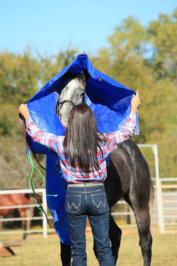
Above: Skye was first apprehensive about the tarp so we fed her on it and rubbed it all over her body until she accepted it.
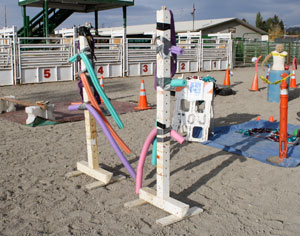
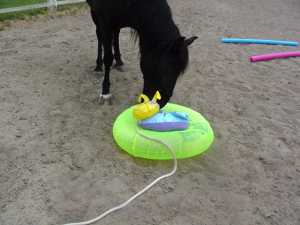
Below: An example of an obstacle course that may be frightening for some horses until they become familiar with it. Riff is sniffing a floatation device in the obstacle course.